← Tarot

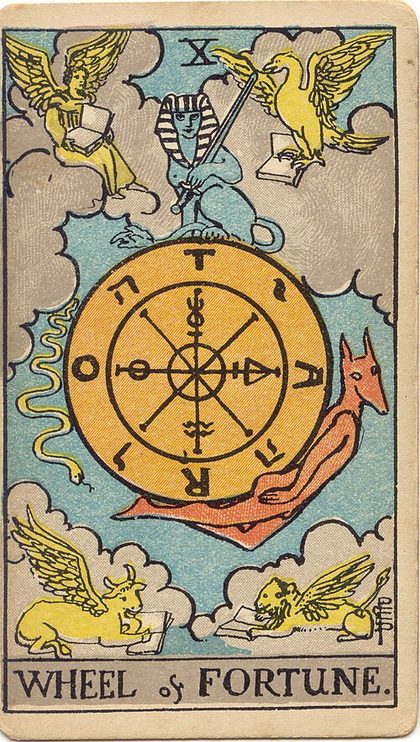
Wheel of Fortune, Waite-Smith tarot, 1909

Major Arcana · X

Wheel of Fortune

♃︎ Jupiter · כ Kaph · Thoth: Fortune

In a reading

The wheel turns. Circumstances are changing beyond your control; meet the change rather than clinging to what was.

Upright
Cycles, fate, turning points, luck
Reversed
Bad luck, resistance to change, breaking a cycle

Correspondences

Number
X
Hebrew letter
כ Kaph, “Palm of the hand” (value 20)
Attribution
♃︎ Jupiter
Golden Dawn title
The Lord of the Forces of Life
Thoth
Fortune
Marseille
La Roue de Fortune
Case’s key word
Rotation
Path on the Tree
The 21st path, joining Chesed and Netzach

The letter

Kaph, the palm of the hand, is the open hand that receives and grasps; palmistry reads destiny in it. It is a Double letter with a final form (ך, value 500); its ordinary value is 20. In Kaplan’s Sepher Yetzirah its opposites are Life and Death.

On the Tree

The 21st path descends from Chesed to Netzach on the Pillar of Mercy, joining Jupiter to Venus, the Greater and Lesser Benefics. It is the path of fortune and reward, of the “Lord of the Forces of Life”.

The Wheel in the Waite deck

Smith’s Wheel floats in the clouds, inscribed with the letters TARO (read also ROTA, TORA, ATOR) and with the Hebrew letters of YHVH alternating, and with the alchemical symbols of Mercury, Sulphur, Salt and Water. A sphinx with a sword sits on top, a serpent (Typhon) descends on the left, and the jackal-headed Hermanubis rises on the right. The four winged creatures of Ezekiel read their books in the corners. Case’s key word is rotation: the cycle of involution and evolution.

Fortune in the Thoth deck

Crowley’s Wheel has ten spokes, for the sephiroth and for Jupiter, and spins in a sky of violet and blue cut by lightning. On it ride the three alchemical principles as beasts: the Sphinx (Sulphur), Hermanubis (Mercury) and Typhon (Salt), the three gunas of Hindu philosophy (sattva, rajas and tamas). Crowley calls it “the universe in its aspect of continual change”, and adds that the only stable point is the centre.

Card image: Pamela Colman Smith, Rider-Waite tarot, 1909 (public domain, via Wikimedia Commons).