← Tarot

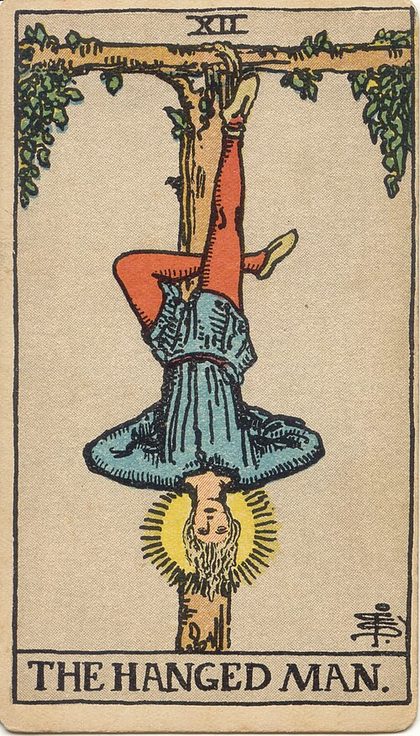
The Hanged Man, Waite-Smith tarot, 1909

Major Arcana · XII

The Hanged Man

Water · מ Mem · Thoth: The Hanged Man

In a reading

Stop struggling. Letting go, waiting or seeing the situation upside down will show you what pushing cannot.

Upright
Surrender, suspension, a new perspective
Reversed
Stalling, needless sacrifice, resistance

Correspondences

Number
XII
Hebrew letter
מ Mem, “Water” (value 40)
Attribution
Water
Golden Dawn title
The Spirit of the Mighty Waters
Thoth
The Hanged Man
Marseille
Le Pendu
Case’s key word
Reversal
Path on the Tree
The 23rd path, joining Geburah and Hod

The letter

Mem, water, is the second Mother letter, a humming sound with closed lips. It has a closed final form (ם, value 600); its ordinary value is 40, the number of the Flood’s days, of the years in the wilderness and of Christ’s days in the desert. In the Sepher Yetzirah, Mem is Water, and the cold and the belly of the human body: “Shin hisses, Mem hums, and Aleph is the breath of air deciding between them.”

On the Tree

The 23rd path descends from Geburah to Hod on the Pillar of Severity: the force of Mars poured into the forms of Mercury. It is the Stable Intelligence, the consistency in all the numbers: water finds its level.

The Hanged Man in the Waite deck

Smith’s Hanged Man hangs upside down by one foot from a living T-shaped tree, his other leg crossed behind to form a 4 (or a cross), his hands behind his back, his face calm and his head ringed by a halo. Waite insisted it is not martyrdom but rapture: “he who can understand that the story of his higher nature is imbedded in this symbolism will receive intimations concerning a great awakening.” Case’s key word is reversal: the reversal of ordinary values, and complete surrender to the divine will.

The Hanged Man in the Thoth deck

Crowley’s Hanged Man hangs from an Ankh in a green and blue grid of disks, his body forming a cross over a triangle (the sign of redemption by sacrifice), with a snake coiled beneath, the serpent of the new life. Crowley considered the card a survival of the old aeon of Osiris, the formula of the dying god, which in the new aeon of Horus gives place to the will that is not sacrificed. He relates it to baptism and drowning: “the immersion of the self in the waters”.

Card image: Pamela Colman Smith, Rider-Waite tarot, 1909 (public domain, via Wikimedia Commons).