The 23rd path · Geburah to Hod
מ
Mem · XII The Hanged Man
Water · Thoth: The Hanged Man
The Twenty-third Path is the Stable Intelligence, and it is so called because it has the virtue of consistency among all numerations.
The Stable Intelligence: The 32 Paths of Wisdom, trans. Westcott
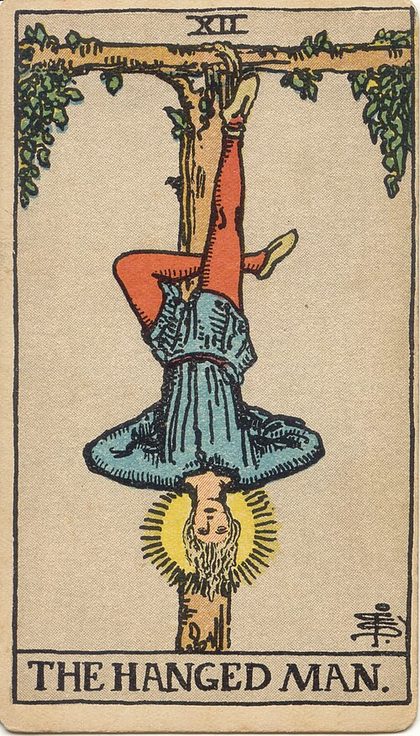
The card
Trump XII, The Hanged Man.
Open The Hanged Man in the Tarot section →
Meanings in a reading, upright and reversed.
Correspondences
- Letter
- מ Mem (מים), “Water”
- Value
- 40
- Kind
- Mother letter (one of the three Mothers: Aleph, Mem, Shin)
- Attribution
- Water
- Tarot trump
- XII · Waite: The Hanged Man · Thoth: The Hanged Man · Marseille: Le Pendu
- Golden Dawn title (Book T)
- The Spirit of the Mighty Waters
- Lévi’s attribution (1855)
- XIII XIII (unnamed)
- Case’s key word
- Reversal
- Colours
- King: Deep blue · Queen: Sea green
- Gods (777)
- Egyptian: Tum-Athoph, Auramoth (as water), Asar (as the Hanged Man), Hekar, Isis · Greek: Poseidon · Roman: Neptune · Hindu: Soma (apas)
- Animals
- Eagle, snake or scorpion (Kerub of Water)
- Plants
- Lotus; all water plants
- Precious stones
- Beryl; aquamarine
- Perfumes
- Onycha; myrrh
- Magical weapon
- The cup and cross of suffering; the wine
The letter
Mem, water, is the second Mother letter, a humming sound with closed lips. It has a closed final form (ם, value 600); its ordinary value is 40, the number of the Flood’s days, of the years in the wilderness and of Christ’s days in the desert. In the Sepher Yetzirah, Mem is Water, and the cold and the belly of the human body: “Shin hisses, Mem hums, and Aleph is the breath of air deciding between them.”
On the Tree
The 23rd path descends from Geburah to Hod on the Pillar of Severity: the force of Mars poured into the forms of Mercury. It is the Stable Intelligence, the consistency in all the numbers: water finds its level.
The Hanged Man in the Waite deck
Smith’s Hanged Man hangs upside down by one foot from a living T-shaped tree, his other leg crossed behind to form a 4 (or a cross), his hands behind his back, his face calm and his head ringed by a halo. Waite insisted it is not martyrdom but rapture: “he who can understand that the story of his higher nature is imbedded in this symbolism will receive intimations concerning a great awakening.” Case’s key word is reversal: the reversal of ordinary values, and complete surrender to the divine will.
The Hanged Man in the Thoth deck
Crowley’s Hanged Man hangs from an Ankh in a green and blue grid of disks, his body forming a cross over a triangle (the sign of redemption by sacrifice), with a snake coiled beneath, the serpent of the new life. Crowley considered the card a survival of the old aeon of Osiris, the formula of the dying god, which in the new aeon of Horus gives place to the will that is not sacrificed. He relates it to baptism and drowning: “the immersion of the self in the waters”.
Where this path leads
Read further
- The Hanged Man on Wikipediahistory and iconography of the card
- Sepher Yetzirah and the 32 Paths of WisdomW. Wynn Westcott, trans., 1887
- The Kabbalah UnveiledS. L. MacGregor Mathers, from Knorr von Rosenroth’s Kabbala Denudata, 1887
- Liber 777 RevisedAleister Crowley, 1909/1955
- The Book of ThothAleister Crowley, 1944
- The Golden DawnIsrael Regardie, ed., 1937–40
- A Garden of PomegranatesIsrael Regardie, 1932
- The Mystical QabalahDion Fortune, 1935
- The Pictorial Key to the TarotA. E. Waite, 1910
- The Tarot: A Key to the Wisdom of the AgesPaul Foster Case, 1947
- A Practical Guide to Qabalistic SymbolismGareth Knight, 1965
Also in the background throughout: Gershom Scholem, Kabbalah (1974) and Major Trends in Jewish Mysticism (1941), for the Jewish tradition as historians understand it; Aryeh Kaplan, Sefer Yetzirah (1990); Kenneth Grant, Nightside of Eden (1977), for the Qliphoth; Robert Wang, The Qabalistic Tarot (1983).