The 11th path · Kether to Chokmah
א
Aleph · 0 The Fool
Air · Thoth: The Fool
The Eleventh Path is the Scintillating Intelligence because it is the essence of that curtain which is placed close to the order of the disposition, and this is a special dignity given to it that it may be able to stand before the Face of the Cause of Causes.
The Scintillating Intelligence: The 32 Paths of Wisdom, trans. Westcott
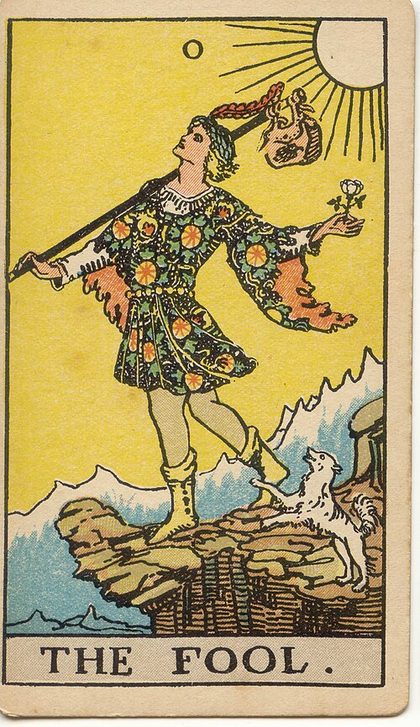
The card
Trump 0, The Fool.
Open The Fool in the Tarot section →
Meanings in a reading, upright and reversed.
Correspondences
- Letter
- א Aleph (אלף), “Ox”
- Value
- 1
- Kind
- Mother letter (one of the three Mothers: Aleph, Mem, Shin)
- Attribution
- Air
- Tarot trump
- 0 · Waite: The Fool · Thoth: The Fool · Marseille: Le Mat
- Golden Dawn title (Book T)
- The Spirit of Æther
- Lévi’s attribution (1855)
- I Le Bateleur
- Case’s key word
- Superconsciousness
- Colours
- King: Bright pale yellow · Queen: Sky blue
- Gods (777)
- Egyptian: Nu, Hoor-pa-kraat (Harpocrates) · Greek: Zeus · Roman: Jupiter · Hindu: the Maruts
- Animals
- Eagle or man (Kerub of Air)
- Plants
- Aspen
- Precious stones
- Topaz; chalcedony
- Perfumes
- Galbanum
- Magical weapon
- Dagger or fan
The letter
Aleph, the ox, is the first letter and the first of the three Mothers. It is silent: a breath, a glottal stop, the sound before sound. The Sepher Yetzirah makes the three Mothers Aleph, Mem and Shin into Air, Water and Fire; Air, “the scale of merit and the scale of guilt, and the tongue of decree deciding between them”, is the balance between Water and Fire. Its value is 1, and spelled in full (אלף) it is 111. The shape is often read as two Yods joined by a Vav: the upper and lower waters divided by the firmament.
On the Tree
The 11th path joins Kether to Chokmah: it is the first motion out of the One, the breath of the spirit before any form. The Golden Dawn calls it the path of the Spirit of Æther, and it is the first of the paths of the Lightning Flash after it leaves Kether.
The Fool in the Waite deck
Pamela Colman Smith’s Fool is a young man in a flowered tunic stepping off a cliff edge with a white rose in one hand and a wand and wallet over his shoulder, a small white dog leaping at his heels and the sun blazing behind him. Waite calls him “the spirit in search of experience”. Case reads the cliff as the edge of manifestation, the white rose as purified desire, the wallet as the stored memories of the race, and the dog as the intellect that follows the spirit.
The Fool in the Thoth deck
Lady Frieda Harris painted Crowley’s Fool as the Green Man of spring, horned like Dionysus Zagreus and Bacchus Diphues, with a crocodile (Sebek, Harpocrates’ beast) in the water at his feet, a tiger fawning at his thigh, and a dove, vulture and butterfly in the spiral caduceus of his whirling movement. He carries a cluster of grapes and a burning pine-cone, and the sun-disc of Hoor-pa-kraat. Crowley calls him the Holy Fool, Parsifal the pure fool, the Great Fool of the Celts, and the “Babe in the Egg of Blue”.
Lévi and the Golden Dawn
Éliphas Lévi, in Dogme et Rituel (1855), gave the Fool to Shin and put the Magician on Aleph. The Golden Dawn’s Cipher Manuscripts moved the Fool, number zero, to the head of the sequence, so that Aleph, the first letter, carries the card of nothing-before-one. Nearly every English-language occult tarot follows the Golden Dawn.
Where this path leads
Read further
- The Fool on Wikipediahistory and iconography of the card
- Sepher Yetzirah and the 32 Paths of WisdomW. Wynn Westcott, trans., 1887
- The Kabbalah UnveiledS. L. MacGregor Mathers, from Knorr von Rosenroth’s Kabbala Denudata, 1887
- Liber 777 RevisedAleister Crowley, 1909/1955
- The Book of ThothAleister Crowley, 1944
- The Golden DawnIsrael Regardie, ed., 1937–40
- A Garden of PomegranatesIsrael Regardie, 1932
- The Mystical QabalahDion Fortune, 1935
- The Pictorial Key to the TarotA. E. Waite, 1910
- The Tarot: A Key to the Wisdom of the AgesPaul Foster Case, 1947
- A Practical Guide to Qabalistic SymbolismGareth Knight, 1965
Also in the background throughout: Gershom Scholem, Kabbalah (1974) and Major Trends in Jewish Mysticism (1941), for the Jewish tradition as historians understand it; Aryeh Kaplan, Sefer Yetzirah (1990); Kenneth Grant, Nightside of Eden (1977), for the Qliphoth; Robert Wang, The Qabalistic Tarot (1983).