The 19th path · Chesed to Geburah
ט
Teth · VIII Strength
♌︎ Leo · Thoth: Lust (XI)
The Nineteenth Path is the Intelligence of all the activities of the spiritual beings, and is so called because of the affluence diffused by it from the most high blessing and most exalted sublime glory.
The Intelligence of all the Activities of the Spiritual Beings: The 32 Paths of Wisdom, trans. Westcott
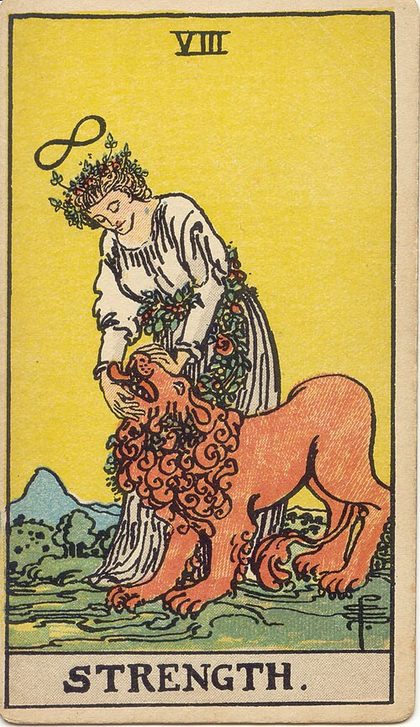
The card
Trump VIII, Strength (Thoth: Lust (XI)).
Open Strength in the Tarot section →
Meanings in a reading, upright and reversed.
Correspondences
- Letter
- ט Teth (טית), “Serpent”
- Value
- 9
- Kind
- Single letter (one of the twelve Singles, given to the signs of the zodiac)
- Attribution
- ♌︎ Leo
- Tarot trump
- VIII · Waite: Strength · Thoth: Lust (XI) · Marseille: La Force (XI)
- Golden Dawn title (Book T)
- The Daughter of the Flaming Sword; the Leader of the Lion
- Lévi’s attribution (1855)
- IX L’Hermite
- Case’s key word
- Suggestion
- Colours
- King: Greenish yellow · Queen: Deep purple
- Gods (777)
- Egyptian: Ra-Hoor-Khuit, Pasht, Sekhet, Mau · Greek: Demeter (borne by lions) · Roman: Venus (repressing the fire of Vulcan) · Hindu: Vishnu (as Nara-Singh, the man-lion)
- Animals
- Lion (Kerub of Fire)
- Plants
- Sunflower
- Precious stones
- Cat’s eye
- Perfumes
- Olibanum
- Magical weapon
- Preliminary discipline
The letter
Teth, the serpent, is coiled power: the serpent of the Garden, the brazen serpent Moses raised in the wilderness, and the kundalini of Indian yoga. Its value is 9; Case gives it the faculty of taste or digestion. The serpent and the lion are the two beasts of this path: Leo is the sign, and the snake its hidden life.
On the Tree
The 19th path runs horizontally from Chesed to Geburah, Mercy to Severity: the second of the three horizontal paths. It is the path of the spiritual beings’ activities, where the fire of Leo is held in balance between the two arms.
The Golden Dawn exchange of VIII and XI
In the Marseille sequence Justice is VIII and Strength XI. The Golden Dawn, to make the trumps follow the zodiac along the letters (Teth is Leo and Lamed is Libra), exchanged them, so that Strength (Leo) became VIII on Teth and Justice (Libra) XI on Lamed. Waite adopted the new numbering. Crowley kept the Golden Dawn’s letters but restored the old numbers, calling the cards Lust (XI) and Adjustment (VIII); this is one loop of his “double loop” (the other is the Emperor and the Star).
Strength in the Waite deck
A woman in white, garlanded with roses and with the lemniscate over her head, gently closes (or opens) the jaws of a red lion. Waite stresses that the strength is that of innocence; Case’s key word is suggestion: the subconscious (the woman) tames the passions (the lion) not by force but by suggestion from the conscious mind.
Lust in the Thoth deck
Crowley transformed the card into Babalon riding the Beast: a naked woman astride a seven-headed lion-serpent, lifting the Holy Graal aflame with love and death, with the reins of passion in her other hand. The heads of the Beast are those of an angel, a saint, a poet, an adulterous woman, a man of valour, a satyr and a lion-serpent (Revelation 17). Behind them are the pale images of the saints whose blood is in the cup. Crowley’s Lust is not mere desire but “the joy of strength exercised”: ecstasy, the strength of the lion become the joy of the dance.
Where this path leads
Read further
- Strength on Wikipediahistory and iconography of the card
- Sepher Yetzirah and the 32 Paths of WisdomW. Wynn Westcott, trans., 1887
- The Kabbalah UnveiledS. L. MacGregor Mathers, from Knorr von Rosenroth’s Kabbala Denudata, 1887
- Liber 777 RevisedAleister Crowley, 1909/1955
- The Book of ThothAleister Crowley, 1944
- The Golden DawnIsrael Regardie, ed., 1937–40
- A Garden of PomegranatesIsrael Regardie, 1932
- The Mystical QabalahDion Fortune, 1935
- The Pictorial Key to the TarotA. E. Waite, 1910
- The Tarot: A Key to the Wisdom of the AgesPaul Foster Case, 1947
- A Practical Guide to Qabalistic SymbolismGareth Knight, 1965
Also in the background throughout: Gershom Scholem, Kabbalah (1974) and Major Trends in Jewish Mysticism (1941), for the Jewish tradition as historians understand it; Aryeh Kaplan, Sefer Yetzirah (1990); Kenneth Grant, Nightside of Eden (1977), for the Qliphoth; Robert Wang, The Qabalistic Tarot (1983).