The 18th path · Binah to Geburah
ח
Cheth · VII The Chariot
♋︎ Cancer · Thoth: The Chariot
The Eighteenth Path is called the House of Influence (by the greatness of whose abundance the influx of good things upon created beings is increased), and from its midst the arcana and hidden senses are drawn forth, which dwell in its shade and which cling to it, from the Cause of all causes.
The House of Influence: The 32 Paths of Wisdom, trans. Westcott
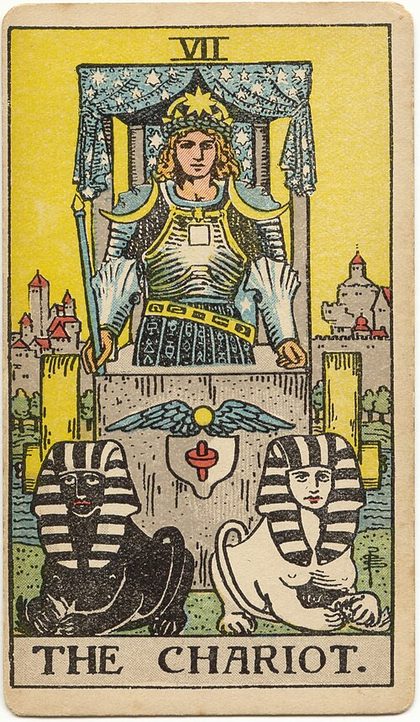
The card
Trump VII, The Chariot.
Open The Chariot in the Tarot section →
Meanings in a reading, upright and reversed.
Correspondences
- Letter
- ח Cheth (חית), “Fence, enclosure”
- Value
- 8
- Kind
- Single letter (one of the twelve Singles, given to the signs of the zodiac)
- Attribution
- ♋︎ Cancer
- Tarot trump
- VII · Waite: The Chariot · Thoth: The Chariot · Marseille: Le Chariot
- Golden Dawn title (Book T)
- The Child of the Powers of the Waters; the Lord of the Triumph of Light
- Lévi’s attribution (1855)
- VIII La Justice
- Case’s key word
- Receptivity (will)
- Colours
- King: Amber · Queen: Maroon
- Gods (777)
- Egyptian: Khephra · Greek: Apollo the Charioteer · Roman: Mercury; the Lares and Penates · Hindu: Krishna (as charioteer)
- Animals
- Crab; turtle; sphinx
- Plants
- Lotus
- Precious stones
- Amber
- Perfumes
- Onycha
- Magical weapon
- The furnace
The letter
Cheth, the fence or field, encloses and protects: the wall around the garden, the shell of the crab, the chariot that carries its rider. Its value is 8; Case gives it the faculty of speech. Spelled in full, חית has the value 418, which Crowley identified with ABRAHADABRA, the Word of the Aeon, and with the Great Work itself; he gave the number to his record of the Aethyrs, Liber 418.
On the Tree
The 18th path descends from Binah to Geburah, on the Pillar of Severity: the Great Mother’s form carried down into strength and action. Its 32 Paths name, the House of Influence, is the vessel through which “the arcana and hidden senses are drawn forth”.
The Chariot in the Waite deck
Waite’s charioteer stands crowned and armoured in a stone chariot under a starry canopy, holding a wand but no reins; the chariot is drawn by two sphinxes, black and white, which he guides by will alone. Crescent moons are on his shoulders and a winged sun on the chariot front. Case’s key word is receptivity: the will that triumphs is the will that lets the higher power drive.
The Chariot in the Thoth deck
Harris’s Chariot is a vision of the Holy Grail: a charioteer in amber armour (the King-scale colour of the path) sits still, holding before him the Graal, a cup of amethyst with blood at its heart, turning like a wheel. Four sphinxes made of the four Kerubim draw the chariot; the canopy is the blue night of Binah. Crowley says that he does not drive but simply sits; his task is to carry the Graal, and the card is the triumph of light protected by the shell of form.
Where this path leads
Read further
- The Chariot on Wikipediahistory and iconography of the card
- Sepher Yetzirah and the 32 Paths of WisdomW. Wynn Westcott, trans., 1887
- The Kabbalah UnveiledS. L. MacGregor Mathers, from Knorr von Rosenroth’s Kabbala Denudata, 1887
- Liber 777 RevisedAleister Crowley, 1909/1955
- The Book of ThothAleister Crowley, 1944
- The Golden DawnIsrael Regardie, ed., 1937–40
- A Garden of PomegranatesIsrael Regardie, 1932
- The Mystical QabalahDion Fortune, 1935
- The Pictorial Key to the TarotA. E. Waite, 1910
- The Tarot: A Key to the Wisdom of the AgesPaul Foster Case, 1947
- A Practical Guide to Qabalistic SymbolismGareth Knight, 1965
Also in the background throughout: Gershom Scholem, Kabbalah (1974) and Major Trends in Jewish Mysticism (1941), for the Jewish tradition as historians understand it; Aryeh Kaplan, Sefer Yetzirah (1990); Kenneth Grant, Nightside of Eden (1977), for the Qliphoth; Robert Wang, The Qabalistic Tarot (1983).