The 16th path · Chokmah to Chesed
ו
Vav · V The Hierophant
♉︎ Taurus · Thoth: The Hierophant
The Sixteenth Path is the Triumphal or Eternal Intelligence, so called because it is the pleasure of the Glory, beyond which is no other Glory like to it, and it is called also the Paradise prepared for the Righteous.
The Triumphal or Eternal Intelligence: The 32 Paths of Wisdom, trans. Westcott
The card
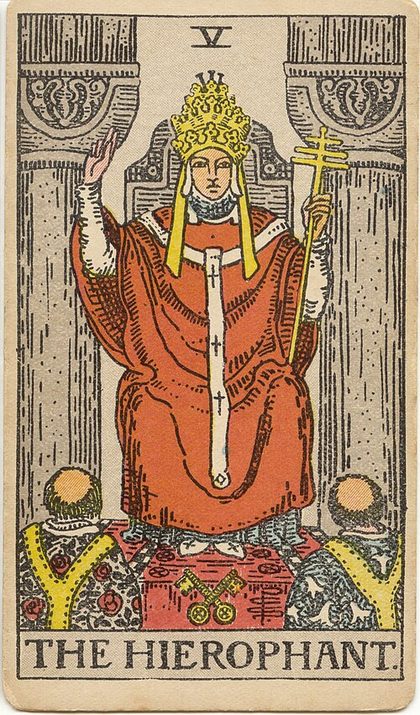
Trump V, The Hierophant.
Open The Hierophant in the Tarot section →
Meanings in a reading, upright and reversed.
Correspondences
- Letter
- ו Vav (וו), “Nail, hook”
- Value
- 6
- Kind
- Single letter (one of the twelve Singles, given to the signs of the zodiac)
- Attribution
- ♉︎ Taurus
- Tarot trump
- V · Waite: The Hierophant · Thoth: The Hierophant · Marseille: Le Pape
- Golden Dawn title (Book T)
- The Magus of the Eternal
- Lévi’s attribution (1855)
- VI L’Amoureux
- Case’s key word
- Intuition
- Colours
- King: Red-orange · Queen: Deep indigo
- Gods (777)
- Egyptian: Asar (Osiris), Ameshet, Apis · Greek: Hera · Roman: Venus · Hindu: Shiva (as Sacred Bull)
- Animals
- Bull
- Plants
- Mallow
- Precious stones
- Topaz
- Perfumes
- Storax
- Magical weapon
- The labour of preparation
The letter
Vav, the nail or hook, joins things together: as a Hebrew word it means “and”. In the divine name YHVH it is the Son, the six sephiroth of Zeir Anpin around Tiphareth (Vav’s value is 6). The hooks (vavim) of the Tabernacle held its curtains to the pillars (Exodus 27). Case gives it the faculty of hearing, and the Hierophant is the one who hears the inner voice.
On the Tree
The 16th path descends from Chokmah to Chesed, on the Pillar of Mercy. It brings the wisdom of the Father down to the throne of the Masters: the path of revelation, the Eternal Intelligence called “the Paradise prepared for the Righteous”.
The Hierophant in the Waite deck
Waite’s Hierophant is a pope in a triple crown, raising his hand in blessing between two grey pillars, with two tonsured acolytes kneeling before him and two crossed keys at his feet. Waite reads him as the outer, orthodox teaching; Case’s key word is intuition, interior hearing: the Hierophant is the inner teacher whose voice is heard when the outer self listens.
The Hierophant in the Thoth deck
Crowley’s Hierophant sits on a bull, flanked by elephants (also Taurean), within the four Kerubic beasts of the Apocalypse. On his breast is a pentagram containing a dancing child, Horus, and before him stands a woman girt with a sword, the Scarlet Woman. Nine nails fasten his oriel window. Crowley says that the Hierophant of the new aeon is the initiator who teaches through the child: the new revelation is Horus, the Crowned and Conquering Child, and the Hierophant’s secret is the union of the microcosm with the macrocosm.
Where this path leads
Read further
- The Hierophant on Wikipediahistory and iconography of the card
- Sepher Yetzirah and the 32 Paths of WisdomW. Wynn Westcott, trans., 1887
- The Kabbalah UnveiledS. L. MacGregor Mathers, from Knorr von Rosenroth’s Kabbala Denudata, 1887
- Liber 777 RevisedAleister Crowley, 1909/1955
- The Book of ThothAleister Crowley, 1944
- The Golden DawnIsrael Regardie, ed., 1937–40
- A Garden of PomegranatesIsrael Regardie, 1932
- The Mystical QabalahDion Fortune, 1935
- The Pictorial Key to the TarotA. E. Waite, 1910
- The Tarot: A Key to the Wisdom of the AgesPaul Foster Case, 1947
- A Practical Guide to Qabalistic SymbolismGareth Knight, 1965
Also in the background throughout: Gershom Scholem, Kabbalah (1974) and Major Trends in Jewish Mysticism (1941), for the Jewish tradition as historians understand it; Aryeh Kaplan, Sefer Yetzirah (1990); Kenneth Grant, Nightside of Eden (1977), for the Qliphoth; Robert Wang, The Qabalistic Tarot (1983).