The 12th path · Kether to Binah
ב
Beth · I The Magician
☿︎ Mercury · Thoth: The Magus
The Twelfth Path is the Intelligence of Transparency because it is that species of Magnificence called Chazchazit, the place whence issues the vision of those seeing in apparitions.
The Intelligence of Transparency: The 32 Paths of Wisdom, trans. Westcott
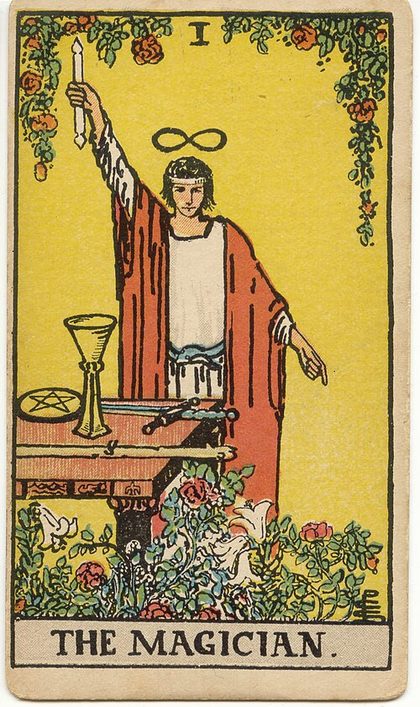
The card
Trump I, The Magician (Thoth: The Magus).
Open The Magician in the Tarot section →
Meanings in a reading, upright and reversed.
Correspondences
- Letter
- ב Beth (בית), “House”
- Value
- 2
- Kind
- Double letter (one of the seven Doubles: Beth, Gimel, Daleth, Kaph, Peh, Resh, Tav)
- Attribution
- ☿︎ Mercury
- Tarot trump
- I · Waite: The Magician · Thoth: The Magus · Marseille: Le Bateleur
- Golden Dawn title (Book T)
- The Magus of Power
- Lévi’s attribution (1855)
- II La Papesse
- Case’s key word
- Attention (self-consciousness)
- Colours
- King: Yellow · Queen: Purple
- Gods (777)
- Egyptian: Thoth, Cynocephalus · Greek: Hermes · Roman: Mercury · Hindu: Hanuman, Vishnu (as Parasu-Rama)
- Animals
- Swallow; ibis; ape; twin serpents
- Plants
- Vervain; herb Mercury; marjoram; palm
- Precious stones
- Opal; agate
- Perfumes
- Mastic; white sandal; mace; storax
- Magical weapon
- The wand or caduceus
The letter
Beth, the house, is the first letter of the Torah: Bereshit, “in the beginning”. The rabbis asked why the Torah begins with Beth and not Aleph, and answered that Beth is closed on three sides and open only forward: we may not ask what is above, below or before creation. It is the first of the seven Double letters, which have a hard and a soft pronunciation, and the Sepher Yetzirah gives each Double a pair of opposites; in Kaplan’s translation, Beth’s are Wisdom and Folly. Its value is 2.
On the Tree
The 12th path joins Kether to Binah: the One reaching towards Form. Its 32 Paths name, the Intelligence of Transparency, and the strange word Chazchazit (vision, the place of seers) mark it as the path through which the divine will is seen. Mercury, the messenger, carries the word of Kether to the Great Mother.
The Magician in the Waite deck
Waite’s Magician stands under a lemniscate (the sign of infinity) with one hand raising a wand to the sky and the other pointing to the earth: “as above, so below.” On the table before him lie the four suit emblems, the cup, sword, wand and pentacle; he wears a white robe with a red mantle and a serpent girdle biting its tail, and roses and lilies grow around him. Case’s key word is attention: the Magician is self-consciousness focusing the forces of the superconscious (the Fool) into the subconscious (the High Priestess).
The Magus in the Thoth deck
Crowley’s Magus is Thoth-Hermes in motion, juggling the instruments of the art (wand, cup, sword, disk, stylus, papyrus and the caduceus) in a field of radiant yellow, while the Cynocephalus ape of Thoth, the image of the deceiving copy, crouches at his feet. Crowley calls him the Word, the Logos, and warns that every word is also a lie: the ape stands for the falsehood inherent in any expression of truth. The card illustrates the doctrine that the Magus speaks the Word of his Will and the universe is made by it.
Lévi and Marseille
In the Marseille deck this is Le Bateleur, the juggler or street conjurer, a sleight-of-hand trickster at a table of cups and balls. Lévi, who gave the card to Aleph, saw him as the Adam Kadmon, the first man, making the shape of Aleph with his arms. The Golden Dawn moved him to Beth and made the trickster into the Adept.
Where this path leads
Read further
- The Magician on Wikipediahistory and iconography of the card
- Sepher Yetzirah and the 32 Paths of WisdomW. Wynn Westcott, trans., 1887
- The Kabbalah UnveiledS. L. MacGregor Mathers, from Knorr von Rosenroth’s Kabbala Denudata, 1887
- Liber 777 RevisedAleister Crowley, 1909/1955
- The Book of ThothAleister Crowley, 1944
- The Golden DawnIsrael Regardie, ed., 1937–40
- A Garden of PomegranatesIsrael Regardie, 1932
- The Mystical QabalahDion Fortune, 1935
- The Pictorial Key to the TarotA. E. Waite, 1910
- The Tarot: A Key to the Wisdom of the AgesPaul Foster Case, 1947
- A Practical Guide to Qabalistic SymbolismGareth Knight, 1965
Also in the background throughout: Gershom Scholem, Kabbalah (1974) and Major Trends in Jewish Mysticism (1941), for the Jewish tradition as historians understand it; Aryeh Kaplan, Sefer Yetzirah (1990); Kenneth Grant, Nightside of Eden (1977), for the Qliphoth; Robert Wang, The Qabalistic Tarot (1983).