The 26th path · Tiphareth to Hod
ע
Ayin · XV The Devil
♑︎ Capricorn · Thoth: The Devil
The Twenty-sixth Path is called the Renovating Intelligence, because the Holy God renews by it all the changing things which are renewed by the creation of the world.
The Renovating Intelligence: The 32 Paths of Wisdom, trans. Westcott
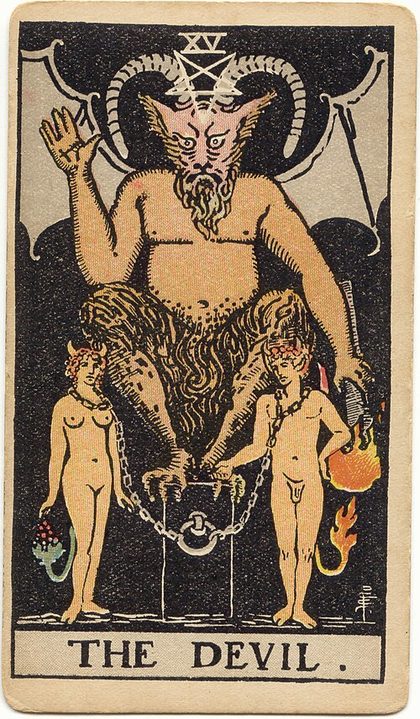
The card
Trump XV, The Devil.
Open The Devil in the Tarot section →
Meanings in a reading, upright and reversed.
Correspondences
- Letter
- ע Ayin (עין), “Eye”
- Value
- 70
- Kind
- Single letter (one of the twelve Singles, given to the signs of the zodiac)
- Attribution
- ♑︎ Capricorn
- Tarot trump
- XV · Waite: The Devil · Thoth: The Devil · Marseille: Le Diable
- Golden Dawn title (Book T)
- The Lord of the Gates of Matter; the Child of the Forces of Time
- Lévi’s attribution (1855)
- XVI La Maison Dieu
- Case’s key word
- Bondage
- Colours
- King: Indigo · Queen: Black
- Gods (777)
- Egyptian: Khem (Set) · Greek: Pan, Priapus · Roman: Pan, Vesta, Bacchus · Hindu: Lingam, Yoni
- Animals
- Goat; ass
- Plants
- Indian hemp; orchis root; thistle
- Precious stones
- Black diamond
- Perfumes
- Musk; civet; Saturnian odours
- Magical weapon
- The secret force; the lamp
The letter
Ayin, the eye (and the spring of water), is a silent letter, a guttural that has lost its sound in most modern pronunciation. Its value is 70, the number of the nations of the world in rabbinic tradition, and of the elders of Israel. Case gives it the faculty of mirth: the Devil is the comedy of appearances, which the enlightened eye sees through.
On the Tree
The 26th path joins Tiphareth to Hod: the heart’s light seen through the forms of the mind. Its 32 Paths name, the Renovating Intelligence, says that through it God renews all things. It is one of the three paths of the Portal grade.
The Devil in the Waite deck
Smith’s Devil is a horned, bat-winged goat-man (after Lévi’s Baphomet) squatting on a black half-cube, holding a lowered torch, with an inverted pentagram on his brow. Chained to his altar are a naked man and woman with small horns and tails; the chains are loose enough to slip off. Case’s key word is bondage: the illusion that we are bound by matter, a bondage that is self-imposed.
The Devil in the Thoth deck
Crowley’s Devil is Pan Pangenetor, the all-begetter: a goat with spiralling horns and a third eye, standing before the trunk of a tree that rises from the earth into the sky, with the winged wand of the Chief Adept in front of him. Below are two great spheres containing tiny figures, the seed of all life struggling to be born. Crowley calls him “creative energy in its most material form”, and refuses the Christian reading: the Devil is Pan. Elsewhere he wrote that “the Devil does not exist. It is a false name invented by the Black Brothers to imply a Unity in their ignorant muddle of dispersions.”
Where this path leads
Read further
- The Devil on Wikipediahistory and iconography of the card
- Sepher Yetzirah and the 32 Paths of WisdomW. Wynn Westcott, trans., 1887
- The Kabbalah UnveiledS. L. MacGregor Mathers, from Knorr von Rosenroth’s Kabbala Denudata, 1887
- Liber 777 RevisedAleister Crowley, 1909/1955
- The Book of ThothAleister Crowley, 1944
- The Golden DawnIsrael Regardie, ed., 1937–40
- A Garden of PomegranatesIsrael Regardie, 1932
- The Mystical QabalahDion Fortune, 1935
- The Pictorial Key to the TarotA. E. Waite, 1910
- The Tarot: A Key to the Wisdom of the AgesPaul Foster Case, 1947
- A Practical Guide to Qabalistic SymbolismGareth Knight, 1965
Also in the background throughout: Gershom Scholem, Kabbalah (1974) and Major Trends in Jewish Mysticism (1941), for the Jewish tradition as historians understand it; Aryeh Kaplan, Sefer Yetzirah (1990); Kenneth Grant, Nightside of Eden (1977), for the Qliphoth; Robert Wang, The Qabalistic Tarot (1983).