The 14th path · Chokmah to Binah
ד
Daleth · III The Empress
♀︎ Venus · Thoth: The Empress
The Fourteenth Path is the Illuminating Intelligence, and is so called because it is that Chashmal which is the founder of the concealed and fundamental ideas of holiness and of their stages of preparation.
The Illuminating Intelligence: The 32 Paths of Wisdom, trans. Westcott
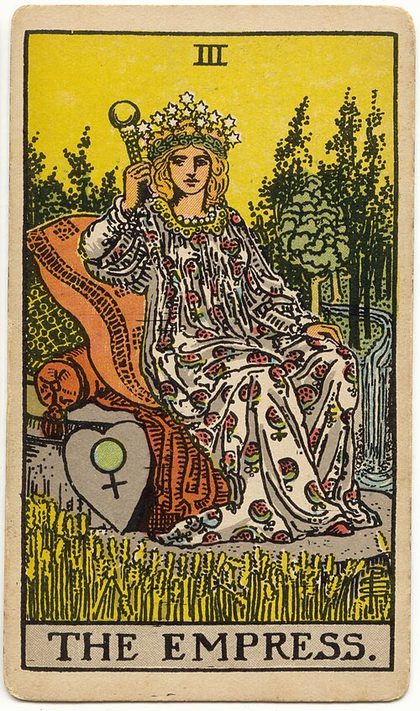
The card
Trump III, The Empress.
Open The Empress in the Tarot section →
Meanings in a reading, upright and reversed.
Correspondences
- Letter
- ד Daleth (דלת), “Door”
- Value
- 4
- Kind
- Double letter (one of the seven Doubles: Beth, Gimel, Daleth, Kaph, Peh, Resh, Tav)
- Attribution
- ♀︎ Venus
- Tarot trump
- III · Waite: The Empress · Thoth: The Empress · Marseille: L’Impératrice
- Golden Dawn title (Book T)
- The Daughter of the Mighty Ones
- Lévi’s attribution (1855)
- IV L’Empereur
- Case’s key word
- Creative imagination
- Colours
- King: Emerald green · Queen: Sky blue
- Gods (777)
- Egyptian: Hathor · Greek: Aphrodite · Roman: Venus · Hindu: Lakshmi
- Animals
- Sparrow; dove; swan
- Plants
- Myrtle; rose; clover
- Precious stones
- Emerald; turquoise
- Perfumes
- Sandalwood; myrtle; all soft voluptuous odours
- Magical weapon
- The girdle
The letter
Daleth, the door, is the opening between inside and outside, the womb-door through which life is born. It is a Double letter, value 4; in Kaplan’s Sepher Yetzirah its opposites are Seed and Desolation. The Golden Dawn liked to point out that the Venus symbol ♀, laid on the Tree, touches every sephirah: it is the only planetary sign that does.
On the Tree
The 14th path runs horizontally from Chokmah to Binah, uniting the Supernal Father and Mother: it is the marriage-bed of the Supernals, the door through which force passes into form. With paths 19 and 27, it is one of the three horizontal “reciprocal” paths that cross the Tree like rungs.
The Empress in the Waite deck
Smith’s Empress sits in a cushioned throne in a field of ripe wheat, with a forest and a waterfall behind her. She wears a crown of twelve stars and a robe printed with pomegranates; a heart-shaped shield with the Venus symbol rests beside her, and she holds a sceptre topped by a globe. Waite calls her “the inferior Garden of Eden, the Earthly Paradise”; Case’s key word is creative imagination, the subconscious made fruitful by self-conscious attention.
The Empress in the Thoth deck
Crowley’s Empress is the Alchemical Salt, the passive principle of nature, crowned and throned with arms and body forming the symbol of alchemical salt. A pelican feeds her young with her own blood; a white double-headed eagle is on her shield; her throne is surrounded by spiralling flames like a gate of light; the sparrow and dove of Venus perch on her. Crowley stresses that she is both the door of birth and the gate of heaven: “the Gate of Heaven”, as her letter Daleth means.
Where this path leads
Read further
- The Empress on Wikipediahistory and iconography of the card
- Sepher Yetzirah and the 32 Paths of WisdomW. Wynn Westcott, trans., 1887
- The Kabbalah UnveiledS. L. MacGregor Mathers, from Knorr von Rosenroth’s Kabbala Denudata, 1887
- Liber 777 RevisedAleister Crowley, 1909/1955
- The Book of ThothAleister Crowley, 1944
- The Golden DawnIsrael Regardie, ed., 1937–40
- A Garden of PomegranatesIsrael Regardie, 1932
- The Mystical QabalahDion Fortune, 1935
- The Pictorial Key to the TarotA. E. Waite, 1910
- The Tarot: A Key to the Wisdom of the AgesPaul Foster Case, 1947
- A Practical Guide to Qabalistic SymbolismGareth Knight, 1965
Also in the background throughout: Gershom Scholem, Kabbalah (1974) and Major Trends in Jewish Mysticism (1941), for the Jewish tradition as historians understand it; Aryeh Kaplan, Sefer Yetzirah (1990); Kenneth Grant, Nightside of Eden (1977), for the Qliphoth; Robert Wang, The Qabalistic Tarot (1983).