The 17th path · Binah to Tiphareth
ז
Zayin · VI The Lovers
♊︎ Gemini · Thoth: The Lovers (The Brothers)
The Seventeenth Path is the Disposing Intelligence, which provides Faith to the Righteous, and they are clothed with the Holy Spirit by it, and it is called the Foundation of Excellence in the state of higher things.
The Disposing Intelligence: The 32 Paths of Wisdom, trans. Westcott
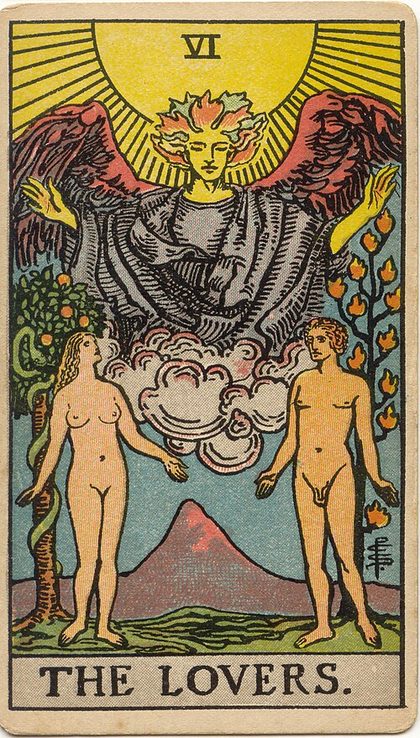
The card
Trump VI, The Lovers (Thoth: The Lovers (The Brothers)).
Open The Lovers in the Tarot section →
Meanings in a reading, upright and reversed.
Correspondences
- Letter
- ז Zayin (זין), “Sword”
- Value
- 7
- Kind
- Single letter (one of the twelve Singles, given to the signs of the zodiac)
- Attribution
- ♊︎ Gemini
- Tarot trump
- VI · Waite: The Lovers · Thoth: The Lovers (The Brothers) · Marseille: L’Amoureux
- Golden Dawn title (Book T)
- The Children of the Voice; the Oracle of the Mighty Gods
- Lévi’s attribution (1855)
- VII Le Chariot
- Case’s key word
- Discrimination
- Colours
- King: Orange · Queen: Pale mauve
- Gods (777)
- Egyptian: twin deities, Rehkt, Merti · Greek: Castor and Pollux, Apollo the Diviner · Roman: Castor and Pollux, Janus · Hindu: the divine twins
- Animals
- Magpie; hybrids
- Plants
- Hybrids; orchids
- Precious stones
- Alexandrite; tourmaline; Iceland spar
- Perfumes
- Wormwood
- Magical weapon
- The tripod
The letter
Zayin, the sword or weapon, divides: it is the cutting edge of discernment. Its value is 7, and it is also the word for the male member, a link the Kabbalists did not miss. Case gives it the faculty of smell, the sense by which we tell good from spoiled. The Lovers is the card of choice, and Zayin is the sword that decides.
On the Tree
The 17th path descends from Binah to Tiphareth, bringing the Supernal Mother’s understanding into the heart. Gemini, the twins, is the sign of duality and its reconciliation; the Disposing Intelligence “clothes the righteous with the Holy Spirit”.
The Lovers in the Waite deck
Smith painted Adam and Eve naked in the Garden, the Tree of Life with twelve flames behind Adam and the Tree of Knowledge with its serpent behind Eve, and the archangel Raphael above them blessing with outstretched arms. Waite calls it, “in a very high sense, the card of human love”; Case’s key word is discrimination: Adam (self-consciousness) looks at Eve (subconsciousness), and Eve looks up to the angel (superconsciousness).
The Lovers in the Thoth deck
Crowley titles it “The Brothers” as well as the Lovers. It shows the Royal Marriage of alchemy: a black king and a white queen are joined by a hooded Hermit-priest, with a blindfolded Cupid aiming his arrow above. Their children, black and white, play at their feet; Eve and Lilith stand behind; the lion and eagle and the winged Orphic egg (prefiguring Art, its sequel on the 25th path) complete the picture. Crowley calls it “the first of the series of alchemical cards”: the Lovers begins the Great Work that Art completes.
Marseille
The older L’Amoureux shows a young man between two women, often read as a choice between virtue and vice or between mother and bride, with a Cupid aiming at him from the sun. The Golden Dawn and Waite replaced the choice with the marriage.
Where this path leads
Read further
- The Lovers on Wikipediahistory and iconography of the card
- Sepher Yetzirah and the 32 Paths of WisdomW. Wynn Westcott, trans., 1887
- The Kabbalah UnveiledS. L. MacGregor Mathers, from Knorr von Rosenroth’s Kabbala Denudata, 1887
- Liber 777 RevisedAleister Crowley, 1909/1955
- The Book of ThothAleister Crowley, 1944
- The Golden DawnIsrael Regardie, ed., 1937–40
- A Garden of PomegranatesIsrael Regardie, 1932
- The Mystical QabalahDion Fortune, 1935
- The Pictorial Key to the TarotA. E. Waite, 1910
- The Tarot: A Key to the Wisdom of the AgesPaul Foster Case, 1947
- A Practical Guide to Qabalistic SymbolismGareth Knight, 1965
Also in the background throughout: Gershom Scholem, Kabbalah (1974) and Major Trends in Jewish Mysticism (1941), for the Jewish tradition as historians understand it; Aryeh Kaplan, Sefer Yetzirah (1990); Kenneth Grant, Nightside of Eden (1977), for the Qliphoth; Robert Wang, The Qabalistic Tarot (1983).