The 13th path · Kether to Tiphareth
ג
Gimel · II The High Priestess
☽︎ Moon · Thoth: The Priestess
The Thirteenth Path is named the Uniting Intelligence, and is so called because it is itself the Essence of Glory; it is the Consummation of the Truth of individual spiritual things.
The Uniting Intelligence: The 32 Paths of Wisdom, trans. Westcott
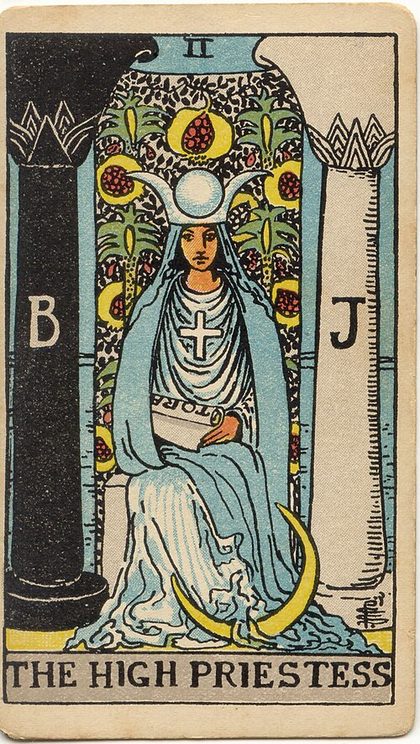
The card
Trump II, The High Priestess (Thoth: The Priestess).
Open The High Priestess in the Tarot section →
Meanings in a reading, upright and reversed.
Correspondences
- Letter
- ג Gimel (גמל), “Camel”
- Value
- 3
- Kind
- Double letter (one of the seven Doubles: Beth, Gimel, Daleth, Kaph, Peh, Resh, Tav)
- Attribution
- ☽︎ Moon
- Tarot trump
- II · Waite: The High Priestess · Thoth: The Priestess · Marseille: La Papesse
- Golden Dawn title (Book T)
- The Priestess of the Silver Star
- Lévi’s attribution (1855)
- III L’Impératrice
- Case’s key word
- Memory (subconsciousness)
- Colours
- King: Blue · Queen: Silver
- Gods (777)
- Egyptian: Chomse (Khonsu) · Greek: Artemis, Hekate · Roman: Diana · Hindu: Chandra
- Animals
- Dog
- Plants
- Almond; mugwort; hazel; moonwort; ranunculus
- Precious stones
- Moonstone; pearl; crystal
- Perfumes
- Camphor; aloes; all sweet virginal odours (777 also lists menstrual blood)
- Magical weapon
- Bow and arrow
The letter
Gimel, the camel, is the ship of the desert, the beast that carries water through the waste. The Talmud reads Gimel and the next letter Daleth together as gomel dalim, “one who gives to the poor”: the camel-rider carrying alms to the door. It is a Double letter; its value is 3, and in Kaplan’s Sepher Yetzirah its opposites are Wealth and Poverty.
On the Tree
The 13th path is the longest on the Tree, running straight down the Middle Pillar from Kether to Tiphareth and crossing the Abyss at Daath. It is the path of the Holy Guardian Angel’s descent and of the mystic’s ascent: the direct line from the human self to the divine, which is why the Golden Dawn calls it the path of the Priestess of the Silver Star and why it is called the Uniting Intelligence. The desert it crosses is the Abyss.
The High Priestess in the Waite deck
Smith’s High Priestess sits between the black and white pillars of Solomon’s Temple, Boaz and Jachin, before a veil embroidered with pomegranates. She wears the triple crown of Isis-Hathor with the moon, a solar cross on her breast, and holds a scroll lettered TORA half-hidden in her robe. A crescent moon lies at her feet. Waite calls her the Secret Tradition and the Shekhinah; Case’s key word is memory, the subconscious that records everything and gives it back.
The Priestess in the Thoth deck
Crowley’s Priestess is Isis as the eternal virgin and Artemis the huntress, veiled in light, with a bow across her knees; her network of light is the veil of Isis that is both concealment and revelation. Fruits, seeds and crystals at the base of the card are the beginnings of life, and a camel walks below. Crowley calls her “the connecting link between the archetypal and the formative worlds”, and also “the most spiritual form of Isis”, pure potential before any image.
La Papesse
In the Marseille deck she is La Papesse, the Female Pope, which some historians link to the legend of Pope Joan and others to the Visconti family’s Guglielmite heretic Maifreda da Pirovano. The Golden Dawn turned her into the Priestess of the Moon.
Where this path leads
Read further
- The High Priestess on Wikipediahistory and iconography of the card
- Sepher Yetzirah and the 32 Paths of WisdomW. Wynn Westcott, trans., 1887
- The Kabbalah UnveiledS. L. MacGregor Mathers, from Knorr von Rosenroth’s Kabbala Denudata, 1887
- Liber 777 RevisedAleister Crowley, 1909/1955
- The Book of ThothAleister Crowley, 1944
- The Golden DawnIsrael Regardie, ed., 1937–40
- A Garden of PomegranatesIsrael Regardie, 1932
- The Mystical QabalahDion Fortune, 1935
- The Pictorial Key to the TarotA. E. Waite, 1910
- The Tarot: A Key to the Wisdom of the AgesPaul Foster Case, 1947
- A Practical Guide to Qabalistic SymbolismGareth Knight, 1965
Also in the background throughout: Gershom Scholem, Kabbalah (1974) and Major Trends in Jewish Mysticism (1941), for the Jewish tradition as historians understand it; Aryeh Kaplan, Sefer Yetzirah (1990); Kenneth Grant, Nightside of Eden (1977), for the Qliphoth; Robert Wang, The Qabalistic Tarot (1983).