The 15th path · Chokmah to Tiphareth
ה
Heh · IV The Emperor
♈︎ Aries · Thoth: The Emperor (Crowley moves this card to Tzaddi; see below)
The Fifteenth Path is the Constituting Intelligence, so called because it constitutes the substance of creation in pure darkness, and men have spoken of these contemplations; it is that darkness spoken of in Scripture, Job xxxviii. 9, ‘and thick darkness a swaddling band for it.’
The Constituting Intelligence: The 32 Paths of Wisdom, trans. Westcott
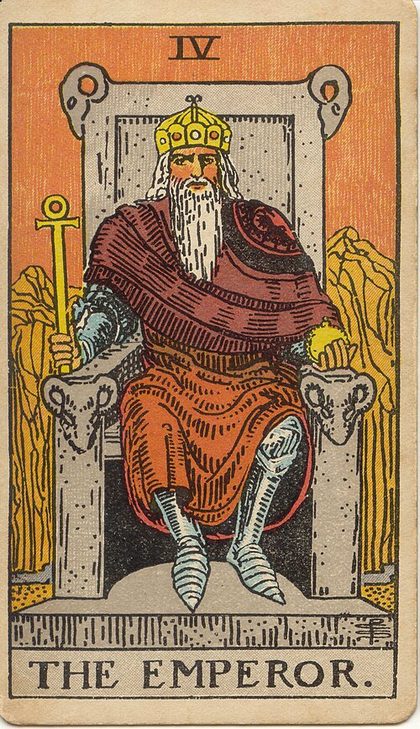
The card
Trump IV, The Emperor (Thoth: The Emperor (Crowley moves this card to Tzaddi; see below)).
Open The Emperor in the Tarot section →
Meanings in a reading, upright and reversed.
Correspondences
- Letter
- ה Heh (הה), “Window”
- Value
- 5
- Kind
- Single letter (one of the twelve Singles, given to the signs of the zodiac)
- Attribution
- ♈︎ Aries
- Tarot trump
- IV · Waite: The Emperor · Thoth: The Emperor (Crowley moves this card to Tzaddi; see below) · Marseille: L’Empereur
- Golden Dawn title (Book T)
- Son of the Morning, Chief among the Mighty
- Lévi’s attribution (1855)
- V Le Pape
- Case’s key word
- Reason
- Colours
- King: Scarlet · Queen: Red
- Gods (777)
- Egyptian: Men Thu (Mentu) · Greek: Athena · Roman: Mars, Minerva · Hindu: Shiva
- Animals
- Ram; owl
- Plants
- Tiger lily; geranium
- Precious stones
- Ruby
- Perfumes
- Dragon’s blood
- Magical weapon
- The horns; energy; the burin
The letter
Heh, the window, is the letter of breath: an aspirated sound, and in the Talmud the letter with which this world was created (Menachot 29b: “this world was created with Heh”). It appears twice in the divine name YHVH, once for the Supernal Mother in Binah and once for the Daughter in Malkuth. It is one of the twelve Single letters, which the Sepher Yetzirah gives to the zodiac and to the human faculties; Case, following the Golden Dawn, gives Heh the faculty of sight. Its value is 5.
On the Tree
The 15th path joins Chokmah, the zodiacal sphere and first force, to Tiphareth, the Sun: it brings the creative fire of the Father down to the heart of the Tree. Its 32 Paths text, the Constituting Intelligence that “constitutes the substance of creation in pure darkness”, describes creation out of the thick darkness before light.
The Emperor in the Waite deck
Waite’s Emperor sits on a stone throne carved with rams’ heads, in red robes over armour, holding an ankh-sceptre and an orb against a background of bare red mountains. He is order, law and authority. Case’s key word is reason: the window (Heh) through which we see, and the constitution of the world by the ordering mind.
Crowley’s exchange: “Tzaddi is not the Star”
In The Book of the Law (I:57) Crowley received the line “All these old letters of my Book are aright; but Tzaddi is not the Star.” He concluded that the Emperor and the Star had been wrongly attributed, and in the Thoth deck the Emperor (Aries) is given Tzaddi and the Star (Aquarius) Heh. To preserve the zodiac he describes a “double loop” in the sequence of trumps: Strength and Justice exchange places around Leo and Libra, and Emperor and Star exchange around Aries and Aquarius. On Crowley’s Tree, therefore, the 15th path carries the Star. The Golden Dawn and Waite keep the Emperor here.
The Emperor in the Thoth deck
Harris painted the Emperor in red and gold, seated with crossed legs that form the figure 4 and with his arms and head making a triangle: together the alchemical sign of Sulphur, the active fiery principle. Rams of Aries flank him; a lamb with a banner (the Agnus Dei) and a bee and fleur-de-lis appear at his feet. His shield bears a red double-headed eagle, the counterpart of the Empress’s white one.
Where this path leads
Read further
- The Emperor on Wikipediahistory and iconography of the card
- Sepher Yetzirah and the 32 Paths of WisdomW. Wynn Westcott, trans., 1887
- The Kabbalah UnveiledS. L. MacGregor Mathers, from Knorr von Rosenroth’s Kabbala Denudata, 1887
- Liber 777 RevisedAleister Crowley, 1909/1955
- The Book of ThothAleister Crowley, 1944
- The Golden DawnIsrael Regardie, ed., 1937–40
- A Garden of PomegranatesIsrael Regardie, 1932
- The Mystical QabalahDion Fortune, 1935
- The Pictorial Key to the TarotA. E. Waite, 1910
- The Tarot: A Key to the Wisdom of the AgesPaul Foster Case, 1947
- A Practical Guide to Qabalistic SymbolismGareth Knight, 1965
Also in the background throughout: Gershom Scholem, Kabbalah (1974) and Major Trends in Jewish Mysticism (1941), for the Jewish tradition as historians understand it; Aryeh Kaplan, Sefer Yetzirah (1990); Kenneth Grant, Nightside of Eden (1977), for the Qliphoth; Robert Wang, The Qabalistic Tarot (1983).